How Much Does It Cost to Sell a House?
Your sale price is not what lands in your bank account. Before you list, add up what comes out of the price so you know your real number, called your net.
1. Your loan payoff
Whatever you still owe on your mortgage, plus any home equity loan, gets paid off at closing. Ask your lender for a payoff amount. It includes interest up to the payoff day.
2. Agent fees
You pay your listing agent's fee, set in your listing agreement. It is negotiable. Buyers now sign their own agreement with their agent, and you may choose to offer help with the buyer's agent fee or other buyer costs to attract offers. Talk it through with your agent before you list.
3. Title, escrow and closing fees
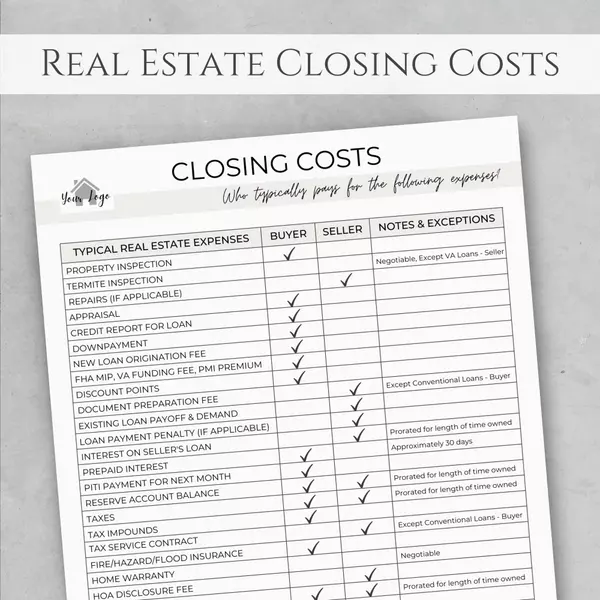
Closing is run by a title company, escrow company or attorney, depending on your state. In many areas the seller pays for the buyer's title insurance policy. Customs differ by state and even by county.
4. Transfer taxes
Some states and counties charge a tax when a home sells. Some charge none. A few examples from our local guides:
- Arizona and Texas: no transfer tax.
- Florida: documentary stamps of $0.70 per $100 under F.S. 201.02, and Miami-Dade sets its own rate.
- Georgia: $1 per $1,000 under O.C.G.A. 48-6-1, on the seller unless the contract moves it.
- Clark County, Nevada: $2.55 per $500, and state law makes buyer and seller both responsible.
- New Jersey: the seller pays the transfer fee, and over $1,000,000 N.J.S.A. 46:15-7.2 adds 1% to 3.5% charged on the whole price, not just the part above $1,000,000. Since July 10, 2025 this is the seller’s, not the buyer’s.
- Massachusetts: deed stamps of $4.56 per $1,000, $6.48 on Cape Cod. State law puts them on whoever signs the deed, which is the seller.
5. Property taxes and HOA
Taxes are split so you pay for the days you owned the home. If you have an HOA, expect a fee for the resale documents and any dues owed.
6. Repairs and credits
After the buyer's inspection, you may agree to fix items or give a credit. You may also agree to pay part of the buyer's closing costs. Plan a cushion for this.
7. Getting ready and moving
Cleaning, small fixes, staging and the move itself. Low-cost staging tips.
Get your real number first
Ask your agent for a seller net sheet: your expected price minus every cost above. Then decide on price and timing with your eyes open.
Quick answers
Do I have to pay the buyer's agent?
No law requires it. You can choose to offer help with the buyer's agent fee or other buyer costs to attract offers. Talk it through with your agent.
Who pays transfer taxes?
It depends on the state and local custom, and it can be negotiated. Some states charge none. See our Phoenix and Tampa guides for examples.
How can I lower my selling costs?
Price right so the home sells fast, fix small items early and compare title fees. See pricing, staging and selling when rates are high.
What's my home worth? · Home selling guide · Sell with AXEN
Where you buy changes this
What a seller owes at closing changes more by state than by anything else.
- New Jersey — over $1,000,000 N.J.S.A. 46:15-7.2 charges the seller 1% to 3.5% of the whole price, and a non-resident seller pays tax at closing.
- Massachusetts — state law charges deed stamps of $4.56 per $1,000, $6.48 on Cape Cod, and the islands add a 2% buyer fee.
- South Carolina — SC Code 12-24-10 charges the seller $1.85 per $500, and the buyer pays it if the seller does not.
- Georgia — O.C.G.A. 48-6-1 charges $1 per $1,000 and puts it on the seller unless the contract moves it.
- Arizona — there is no transfer tax, but a septic system has to be inspected before transfer.
- Louisiana — only New Orleans charges a documentary transaction tax, and the seller pays it.
We keep a page for every state we work in, with a cost table, a step-by-step timeline and the rules that actually trip people up. See all AXEN locations.
Sources and further reading
Updated September 18, 2026. We check these sources each time we update this guide. See our editorial policy.
Recent Posts